There’s a moment from my playing career that I still remember vividly.
I walked into a coach’s office years ago and asked a simple question:
“Am I in your future plans?”
Before I even finished speaking, he laughed in my face.
Not a smile. Not an awkward chuckle. A genuine laugh — the kind that tells you everything you need to know without another word being spoken.
At the time, it crushed me.
When you’re young, you believe hard work is supposed to guarantee opportunity. You believe loyalty matters. You believe if you sacrifice enough, dedicate enough, and perform well enough, eventually somebody will notice.
But soccer doesn’t always work like that.
And honestly, life doesn’t either.
What most players see now is a coach standing on the touchline giving instructions. They see the sessions, the games, the standards, the expectations. What they don’t always see is the road that built the person standing there.
They don’t see the injuries.
They don’t see the surgeries.
They don’t see the scholarship offers disappearing one by one after a serious injury changed the trajectory of an entire career.
They don’t see the gap year where everything feels uncertain and everybody around you seems to be moving forward while you’re trying to figure out how to rebuild yourself from scratch.
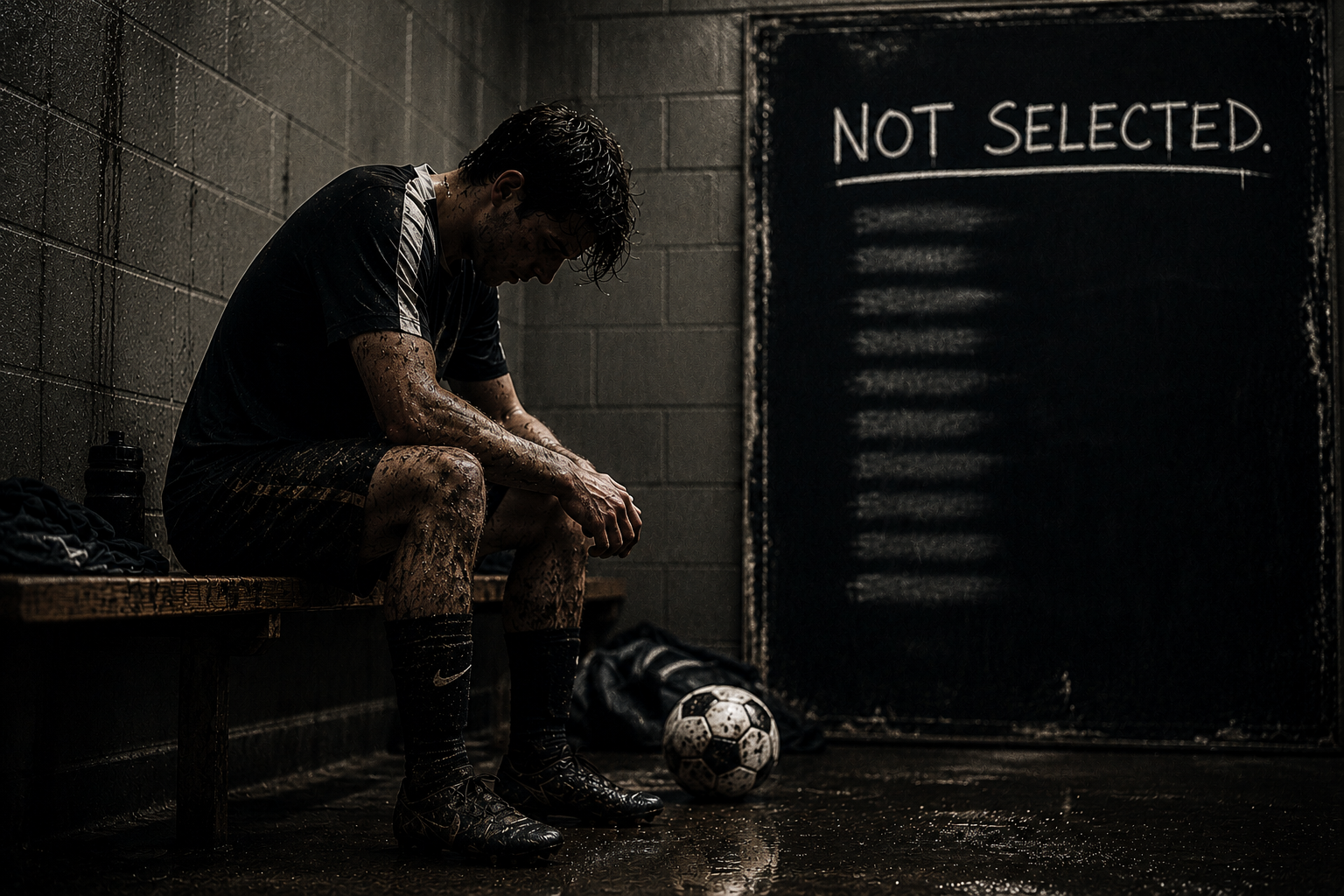
They don’t see what it feels like to be on a team that publicly posted a “no-travel” and “no-dress” list every single week.
Every week.
No matter how hard I trained.
No matter how committed I was.
No matter how much I sacrificed.
No matter how many players I outperformed.
My name was there.
Again.
And again.
And again.
There’s a unique loneliness that comes with giving everything you have to something while feeling invisible at the same time.
A lot of players today experience disappointment for the first time and immediately think it means the journey is over.
It isn’t.
Sometimes the moments that embarrass you, isolate you, and break your confidence are the exact moments that build the foundation for who you eventually become.
At the time, I didn’t realize it, but those experiences were shaping me far beyond soccer.
I had to rebuild my body after injury.
I had to rebuild my confidence after rejection.
I had to rebuild my mentality after constantly feeling overlooked.
Most importantly, I had to rebuild my resilience.
And that process changed my life.
Because eventually, I stopped focusing on proving people wrong and started focusing on becoming stronger regardless of what people thought of me.
That mindset carried me into coaching.
Now when I speak to players dealing with setbacks, I understand them because I lived it.
When a player feels overlooked, I understand.
When a player doesn’t make the travel roster, I understand.
When a player feels like they’re behind everyone else physically, mentally, or technically, I understand.
When a player questions whether they belong at the level, I understand.
And the truth is, I’ve probably experienced worse.
That’s not said to diminish what young players are feeling. Their emotions are real. Their frustration is real. Their disappointment is real.
But perspective matters.
Adversity is not always punishment.
Sometimes it’s preparation.
Some of the strongest players, leaders, and people are built in moments where nobody is clapping for them.
The sessions nobody sees.
The rejection nobody understands.
The recovery nobody celebrates.
The extra work that happens after confidence has already been shattered.
That’s where growth really begins.
Too many young players today are taught to view every obstacle as evidence they’re being held back rather than an opportunity to develop something deeper within themselves.
Resilience.
Discipline.
Self-awareness.
Humility.
Mental toughness.
The ability to keep moving forward when validation disappears.
Those qualities matter far longer than youth soccer results ever will.
I tell my players all the time:
You can use hardship as an excuse, or you can use it as fuel.
You can let rejection define you, or you can let it sharpen you.
You can become bitter, or you can become better.
For me, the game eventually became bigger than playing.
The pain, the setbacks, the embarrassment, the isolation — all of it helped shape how I lead players now.
I coach with empathy because I know what struggle feels like.
I coach with standards because I know how damaging low expectations can become.
And I coach with belief because sometimes all a young player needs is one person who refuses to give up on them.
Soccer development is rarely linear.
Some players dominate early and disappear later.
Others struggle quietly for years before eventually breaking through.
The timeline is different for everyone.
But the players who survive the longest are usually not the most naturally gifted.
They’re the most resilient.
The ones willing to rebuild themselves over and over again.
Those are the players who last.
Those are the players who grow.
And those are usually the players who become the strongest people long after the game is over.



Leave a Reply